When Should You Trust Experts?

We are in the midst of an era marked by a radicle loss of trust in Science and Public Health—certainly not news to anyone with a heartbeat and some cortical activity. People fall mostly into two camps when it comes to assigning blame for this, generally following the political tribalism of today’s society. It’s either to be laid at the feet of the know nothing Luddite science skeptics, starting with the most heinous of vaccine rejectors, and those social media “Influencers” who profit by amplifying people’s distrust of government and authority in general—or alternatively ascribed to over-reaching, pontificating scientists fronting for an ever growing authoritarian government. Scientists and government bureaucrats spewing made up edicts, and pretending they are based in scientific fact. Take your pick depending on your tribal face paint. If the thought has crossed your mind, even briefly, that there might be some kernel of truth to both assessments then welcome to “Clear and Present Thinking”.
The public has been admonished to “follow the science”, as if anything adorned with that name is to revered and never questioned. The recent Pandemic showed us how anti-scientific certain elements of the scientific community and government powers can be when their decisions are questioned. The basic tenets of the scientific method determine that scientific truth is reached by the process of other researchers taking published results and demonstrating that those results are reproducible. Unfortunately we live in an era when the majority of published scientific results cannot be replicated by other researchers. Results that can’t be repeated in other hands and other labs have no claim as scientific fact. Their conclusions may be worth about as much as asking your aunt Betty (or Anthony Fauci) if cloth mask mandates are effective in preventing the spread of a novel respiratory pathogen.
How bad is this problem? Scientists themselves feel it’s pretty acute—a 2016 survey of over 1,500 scientists found that about 90% believed that a significant or at least some reproducibility crises existed. More than 70% of this group reported having tried and failed to replicate other scientist’s findings. A 2015 report in the journal Science looked at the results of 100 replication studies of findings previously published in prominent psychology journals, and found that only 36% yielded concordant statistically significant results, compared to 97% of the original reports. This is a problem across the life sciences in particular, and large scale studies of reproducibility have indicated the dismal result that between 10-25% of published results can be replicated. That is a shocking record; as a society we are expending an enormous amount of money on scientific endeavors, and should quite frankly expect a much better return on the investment. At the very least we should not have to suffered ridicule, condemnation and censorship by government functionaries or media journalists (who might not accurately identify scientific fact from a balogna sandwich) when we question the actual scientific basis for assertions promulgated as “the Science”, or critique obviously flawed or lame studies.
What are the causes of so much flawed science, and are there any remedies?
1. Academic career advancement is based upon publishing articles. Quantity counts over quality, and apparently sometimes high profile prestigious journals can’t identify quality.
2. Scientific journals exist to publish articles. There has been an explosion in the global number of such journals in recent decades, from about 10,000 twenty years ago to roughly 28,000-30,000 ten years ago. Here is a sobering thought, today nobody knows with certainty how many such enterprises exist around the world; estimates range as high as 46,000. An equally scary fact is that an estimated 15,000 of these are “predatory journals”, the bottom of the barrel rags, where for a fee they will publish the submitted dreck of the unscrupulous “scientist”to pad his or her (or they?) resume. If you are so inclined, there are lists of these predatory journals and you can query AI for specific information.
3. The peer review process itself is often flawed with reviewers passing judgement on material which is not within their realm of expertise, and certainly containing arcane statistical data manipulations, that the reviewer often accepts without critical understanding.
You’ve heard the old adage, “There’s more than one way to skin a cat”, well nowhere is that more applicable than in the realm of data set analysis. This statistical massaging of the data until the desired outcome is shown is so pervasive in both the social sciences and observational medical studies as to be laughable. The data can be analyzed in a gigantic number of different ways with various confounders factored in, or not, and weighted to suit the whims of the statisticians and primary researchers.
The vast majority of published studies are retrospective observational adventures seeking to demonstrate an association between some variables, which were recorded years or even decades ago, using definitions which change over time, and accuracy that varies wildly from one observer to another. The very best of these studies, using accurate data sets and with minimal statistical shenanigans can only show an association and never causation.
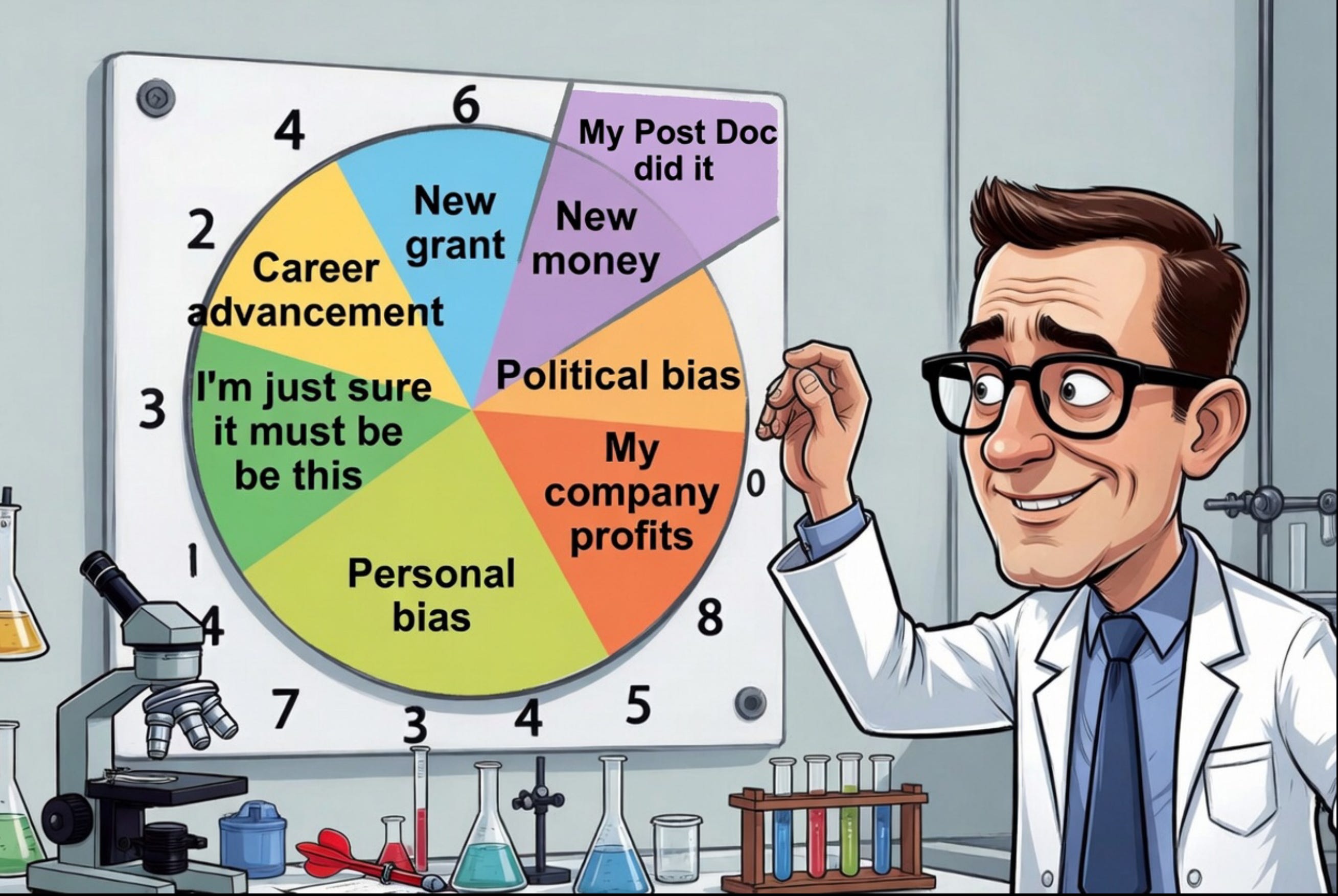
Scientists as a group are no more trustworthy than plumbers, computer programers, doctors or lawyers. To think otherwise is to ignore human nature. A few rotten apples spoil this bunch just as readily. Career advancement, is one factor favoring shoddy science, but personal bias about a question, prior career publishing history, political motivations (we certainly saw enough of that in recent years), desire to conform to prevailing narratives that lead to maximal chances of grant funding, and even monetary rewards can all be operative.
The media today plays an outsized role in determining what is accepted as quality science and hence scientific fact. I’ve already indicated my assessment about the vast majority of science journalists and the bologna sandwich—now I feel compelled to apologize to the lunch meat. Furthermore, you likely couldn’t find a group of non-politicians more inclined to exercise their political bias to deceive the public.
It’s not infrequent for scientists to present their opinions, without even the trappings of some shoddy observational study in support, as scientifically validated facts. Obviously this is most likely to be observed when the scientist is famous, or at least in the public eye as a spokesperson for government public health authority. The amount of damage to public perception of and trust in science when it’s later revealed that, not only was the pronouncement wrong, but that it was predicated solely on opinion, is incalculable. I believe that many lay people have a good understanding that science progresses, and today’s scientific fact may be replaced by new data that contradicts a previous finding—they also understand quite well the difference between fact and opinion, and when they have been deceived.
Finally, and specific to vaccines, the polarization of society currently around this issue I believe makes certain scientists very eager to report positive findings for a vaccine, and loath to report a negative result on vaccine effectiveness, or side effects. As you know I hold most vaccines in extremely high regard, and my comments throughout this post are intended to refer to a small minority of researchers. Nonetheless the entire scientific community is well aware of the problems I have discussed, and has done essentially nothing to address them .
Let’s take a look at a recent high profile vaccine study which was widely reported in the media, apparently without any critical analysis by either the peer reviewers or the journalists. The study of 1,039,650 US Veterans with a mean age of 70.1 years was published in JAMA Intern Med on June 15th, 2026. The end points of interest compared the incidence of COVID-19 associated cardiovascular death, stroke, myocardial infarction, or heart failure between those subjects receiving the 2024-2025 season COVID-19 vaccine or not. Secondary end points were: all cause MACE (major adverse cardiovascular events), hospitalizations or all cause deaths. The analysis concluded the vaccine had a 37% effectiveness in preventing COVID associated cardiovascular morbidity. Sounds impressive, but that was equal to a REDUCTION OF 2 EVENTS per 10,000 people. This is the old relative versus absolute reduction game; the journalist reporting on the results will always read you the relative percentages for the supposedly important study. The “protective effect” was only statistically significant for a subgroup over 75 years old, where the researchers found a vaccine effectiveness 50.7% or a REDUCTION OF 5 EVENTS for every 10,000 people vaccinated. Remarkably, the effect of vaccination was greater when they looked at the secondary endpoints of all cause cardiac morbidity and mortality not just COVID 19 related.
You may be thinking, “what an incredible vaccine, it’s even more effective at preventing death from all sorts of things not even COVID19 related. (The authors surmised that there must have been a lot of undiagnosed COVID19 in these hospitalized patients—surely that must be it!) But it gets even better. Buried in the supplemental tables of the paper are data showing that the mortality curves begin to diverge before two weeks from vaccination have passed. Let’s do a little thought experiment of the kind beloved by Albert Einstein. There are very few people in this cohort of over a million folks (all of whom have either been previously vaccinated, had COVID more than once, or both) who are destined to get sick enough from COVID19 to have an MI or die from it. From the day they are vaccinated, some highly variable period of time will pass before each individual becomes infected, and then another week or so will pass before they are symptomatic enough to come to any kind of medical attention. Then the ones who become very sick will be in the hospital generally for weeks, in some cases a month or more before they finally die. It is not possible for this vaccine, which perhaps at best reduces 5 events per 10,000 people over the course of the 8 month study period, to act so quickly that mortality curves diverge before 2 weeks. Because this is a “test negative” designed trial, it is just another fancy, dressed up, observational study. It is not a randomized controlled trial, or even a natural experiment where some external event has effectively pseudo-randomized participants based solely on say their birth before a certain date. What the study is reporting is just noise caused by the lack of true randomization of the two groups—the subjects motivated to get vaccinated and able to make it to a clinic visit are distinctly different from the other group, the “well vaccinee effect”. Rather than journalists calling it a landmark study, “proving the continued effectiveness of the COVID19 vaccine in preventing serious morbidity”, it should never have been published. Why then does it appear in JAMA? Please refer to any and several of items 1 through 9 in the previous section for the answers. Vinay Prasad in his substack has an excellent discussion of identifying bogus observational studies which exhibit accelerated divergence, that is not biologically plausible, between the two groups under comparison. I will point you to another Prasad post from June 27th, entitled Marc Tessier-Lavigne and Jose Baselga, if you want to read more about, “Data manipulation and conflicts of interest in the Academy”. You may recall that MTL was the extensively published cancer researcher who was also President of Stanford University, until other experts in the field began closely examining his work over decades and found extensive evidence of data manipulation, image altering and other signs of results falsification. He was forced to resign from Stanford, but don’t worry—he is currently Chairman and CEO of Xaira Therapeutics (an artificial intelligence driven biopharmaceutical startup) doing whatever it is he does best.
What’s the largest ongoing epidemic you may never have heard of? It’s certainly not Hanta Virus or even the Bundibugyo strain of Ebola in central Africa. Since mid March, Bangladesh has recorded over 100,000 suspected measles cases (this is a pretty easy clinical diagnosis, especially during an epidemic), and recently just over 1000 new cases in 24 hours with no sign of slowing. So far they have recorded 716 measles deaths, which far eclipses the 1300 Ebola cases and 362 confirmed deaths. The vast majority of cases continue to occur in the chronically dysfunctional DRC with some spillover to Uganda. I have fantasies of strapping RFK Jr. to a chair with his glassies held open with clamps Clockwork Orange style, to watch some footage from Bangladesh—actually why stop there, theaters around the country would be a good idea.

Here is the exotic pathogen section you have all been waiting for. It’s exciting for me as well since this bug is new to me also. Rickettsia lanei, an infection spread from ticks has now been reported in the fourth human ever. Three of the cases have been in northern California and the other from Oregon. Rickettsia, for the non-biologists, are intra-cellular bacteria, which unlike most other bacteria can only exist and reproduce inside living host cells. The handful of cases indicate that this organism causes a severe Rocky Mountain Spotted Fever-like illness, which is potentially life threatening without treatment. The Pacific Coast tick appears to be the vector of human transmission; the bacteria has also been isolated from a species of rabbit tick but these are not known to feed on humans. It’s high tick season once again. There are approximately 20 tick-born maladies found in North America. I could give you the list but instead I will just say: use insect repellant and long pants tucked into socks and boots, make sure you do careful tick checks especially on children after outdoor activities, treat your dogs with appropriate preventatives as advised by your vet….and have a good time in the great outdoors.
Just a few days until July 4th and the 250th celebration of the best imperfect country in the world. America was made GOOD by it’s founding as a Constitutional Republic and Representative Democracy, a distinct aberration in the 18th century when there were only a handful of proto-democracies in the world, and the others, like the Dutch Republic or San Marino, gave preference in voting to hereditary nobles or merchant oligarchs. America became BETTER when it fought a civil war to end slavery, a system that, contrary to what you may have heard, white Anglo-Saxons did not invent, but was virtually a universal feature of societies across the globe for millennia. The reprehensible institution of slavery still exists in multiple countries around the world, (and is even legally sanctioned in Afghanistan), I’ll leave you to surmise where else in world it still festers. The FURTHER IMPROVEMENT of America continued with the extension of voting rights to women in 1920. By the end of that year only the following countries had granted voting to women: New Zealand and Australia, Canada, Finland, Norway, Denmark and Iceland, Germany, Austria, the Netherlands, Luxembourg, Poland, Czechoslovakia, Russia Estonia, Latvia, Lithuania, Armenia and Georgia. For the record these are all Western Civilization countries, and most gave women the vote almost simultaneously at the end of WWI. While Canada and Australia specifically denied indigenous people the right to vote until 1960, in the US, voting rights were guaranteed to all formerly enslaved Black males by the 15th Amendment of the Constitution in 1870. Their Constitutional right to vote and many other basic rights were of course denied by the southern Democrats until the STILL FURTHER IMPROVEMENT of America through the Civil Rights legislation era of the 1960’s. If you want the country to be perfect, remember it would only be perfect in your eyes, and only some of your tribe mates; it would be distinctly imperfect to a whole lot of other folks, maybe even a majority. That’s what this messy thing called Democracy or a Constitutional Republic is all about. Nobody gets things just the way they want it ALL the time, or even some of the time. We can however still hope for some MORE EXCEPTIONAL IMPROVEMENT.
ENJOY THE HOLIDAY-
Excellent. Thank you. I like The Chair idea